

The research group has made significant progress in the field of Rydberg molecules
Recently, our research group published a study titled "Microwave photo-association of fine-structure-induced Rydberg (n+2)D5/2nFJ macro-dimer molecules of cesium" in the international physics journal Physical Review Research. Ph.D. candidate Jingxu Bai is the first author. Professors Yuechun Jiao and Jianming Zhao, together with Professor Georg Raithel from the University of Michigan (USA), are the corresponding authors. Ph.D. candidate Song Rong also participated in this work.
multipole interactions between Rydberg atom pairs can generate bound potential wells, leading to the formation of giant molecules composed of two Rydberg atoms - a binding mechanism fundamentally distinct from both ionic and covalent bonding. This type of molecule is a novel Rydberg polymer that does not exist in nature, which not only contains the excellent properties of the Rydberg atom, but also has a large size, small confinement energy and rich energy level structure, and the internal degrees of freedom and symmetry resources that can be measured and manipulated are very rich, and it is easy to realize the quantum coherence manipulation of the light field, which provides an important platform for the study of novel few-body phenomena, multi-body quantum-related state states and novel ionic interactions.
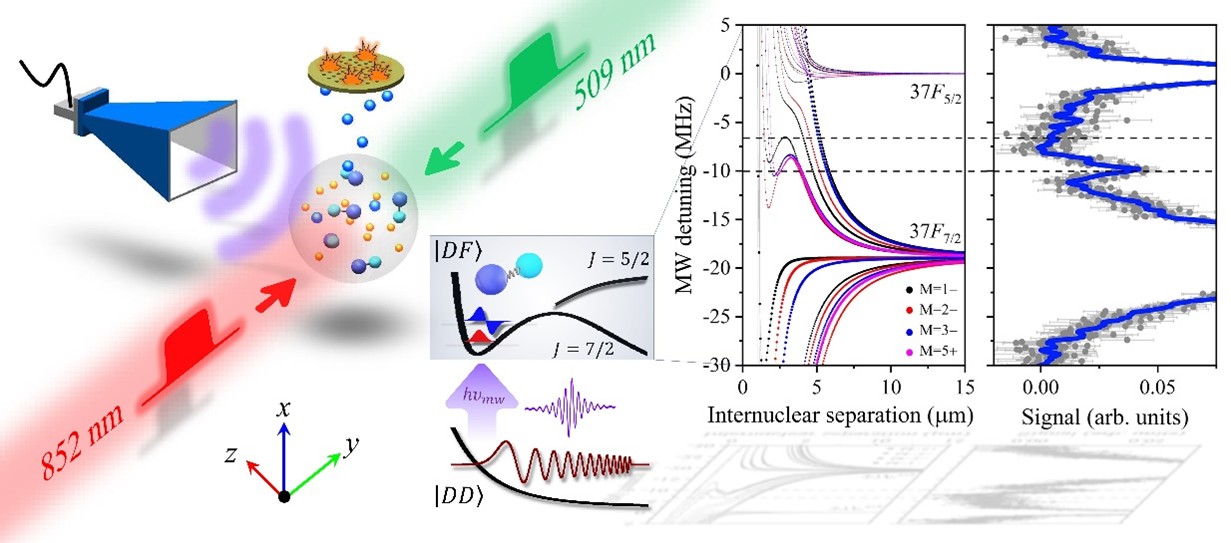
The research team proposed an experimental scheme for microwave optical association, and for the first time, the (n+2) DnF Riedelberg macromolecule induced by the fine structure of the high angular momentum Rydberg state was observed in the experiment using the ultra-narrow linewidth microwave optical association spectrum. Research findings demonstrate that in low-temperature Rydberg atomic systems, strong dipolar "flip-flop" and "cross" interactions induce an avoided crossing of fine-structure potential energy curves, resulting in the formation of MHz-scale bound potential wells and consequently generating DF Rydberg macro-molecules with mixed fine-structure energy levels. We experimentally investigated the binding mechanisms of Rydberg molecules and measured their high-resolution microwave photo-association spectra in weakly dressed static electric fields. Due to the strong Stark effect and the influence of high-angular-momentum Rydberg states, the polarizability of the microwave-transition-generated Rydberg macro-molecules is approximately 2.5 times that of Rydberg atoms, and the intramolecular dipole-dipole interactions cause significant broadening of the microwave photo-association spectra. This study proposes a new association scheme. The microwave photoassociation spectroscopy with narrow linewidth provides new experimental evidence and techniques for investigating the rovibrational structure of molecules, exploring and refining the Born-Oppenheimer interaction potential model of Rydberg macromolecules, and searching for Franck-Condon tuning.
This work was supported by the National Natural Science Foundation of China (Key Program), and the Excellent Youth Project of Shanxi Provincial Basic Research Plan.
Article link: https://doi.org/10.1103/PhysRevResearch.6.023139