

The research group has made significant progress in experimental studies of Rydberg single-photon systems.
Recently, the research team led by Professors Suotang Jia, Jianming Zhao, and Yuechun Jiao from our institute has achieved significant progress in suppressing the motional decoherence of Rydberg collective excited states. Their findings were published in "Physical Review Letters" under the title "Suppression of motional dephasing using state mapping". Professor Yuechun Jiao, doctoral student Changcheng Li, and Professor Xiaofeng Shi (Hainan University)are co-first authors of the paper. Professor Jianming Zhao, Professor Xiaofeng Shi, and Professor C. Stuart Adams ( Durham University (UK) )serve as co-corresponding authors. Dr. Jingxu Bai, a young faculty member, contributed to this research, and Professor Suotang Jia provided important guidance for this work.
Rydberg collective excited states, also known as Rydberg W states or Rydberg dark-state polaritons, enable the mapping of strong interactions between Rydberg atoms onto individual photons through the all-optical electromagnetically induced transparency (EIT) method. This approach holds tremendous potential for applications in quantum optics and quantum information processing. Research based on Rydberg collective excited states has achieved remarkable progress in various fields, including the generation of single-photon sources, single-photon switches and transistors, optical quantum logic gates, non-contact quantum optics, and all-optical networks. However, the thermal motion of atoms leads to rapid decoherence of Rydberg collective excited states, with corresponding coherence times as short as only a few microseconds, which significantly hinders the further development of Rydberg-mediated in quantum optics. Common techniques to mitigate motional decoherence include spin echo, bang-bang protocols, and quantum dynamical decoupling protocols. However, these methods remain ineffective against decoherence caused by the random motion of atoms in real space.
The research team has developed a new all-optical quantum state mapping approach that efficiently suppresses decoherence of Rydberg collective excited states induced by atomic thermal motion in real space. Theoretically, this approach can completely eliminate thermal-motion-induced decoherence, leaving only the intrinsic lifetime of Rydberg atoms as the decoherence channel. Experimentally, we designed a π-wait-π all-optical manipulation protocol, in which Raman couples the initial Rydberg state with another Rydberg state to apply a priori unknown but correct phase to each Rydberg atom in the atomic synthesis, and the resulting phase is directly proportional to the unknown thermal motion velocity, so that when the signal photon is restored, the Rydberg atom does not seem to have thermal motion, thus inhibiting the decoherence caused by atomic motion. Despite the influence of laser and ambient noise in the experiment, we improved the coherence time of the Reedberg collective excited state by more than an order of magnitude. The research results will break the bottleneck of the development of quantum optics mediated by Rydberg and open up new prospects for the research of Riedelberg's quantum many-body physics and other quantum technologies.
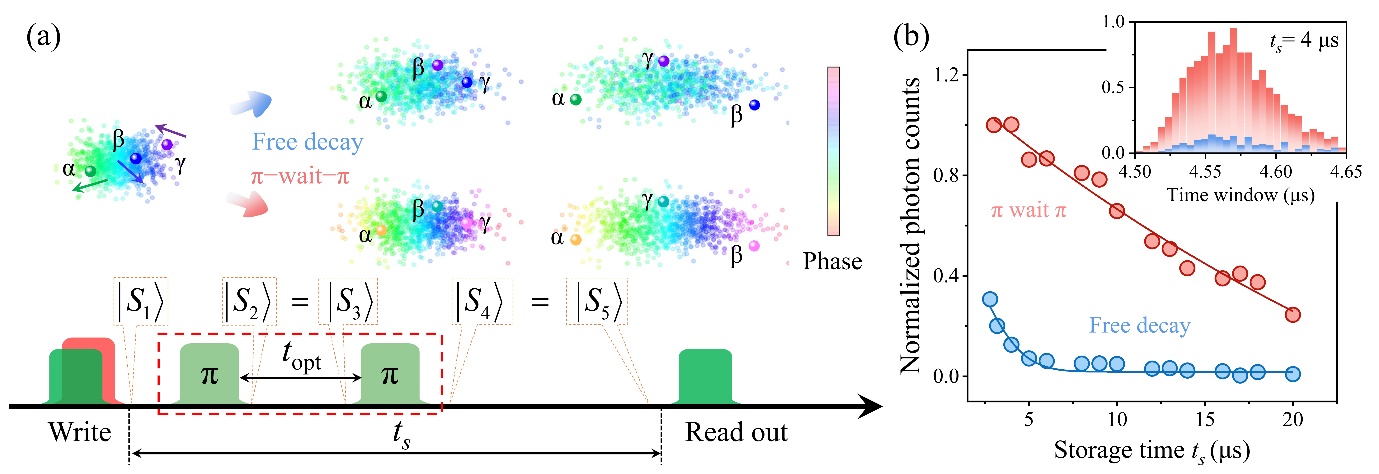
Picture1(a)Comparison between Free Decoherence and Eliminated Decoherence Phases in Rydberg Collective Excited States,(b)Comparison of Readout Signals: Free Decoherence vs. Suppressed Decoherence.
This work was supported by the National Natural Science Foundation of China, the Major Project for Technological Innovation 2030, the Excellent Youth Fund Project of Shanxi Province, the State Key Laboratory of Photonic Quantum Technology and Devices, and the Provincial-Ministerial Coordinated Innovation Center for Extreme Optics.
Paper link:https://link.aps.org/doi/10.1103/PhysRevLett.134.053604